
E-commerce Website Development Cost in India (2026 Pricing Guide)
A transparent breakdown of costs for Shopify, WooCommerce, and Custom builds in 2026 plus the hidden fees most founders miss.

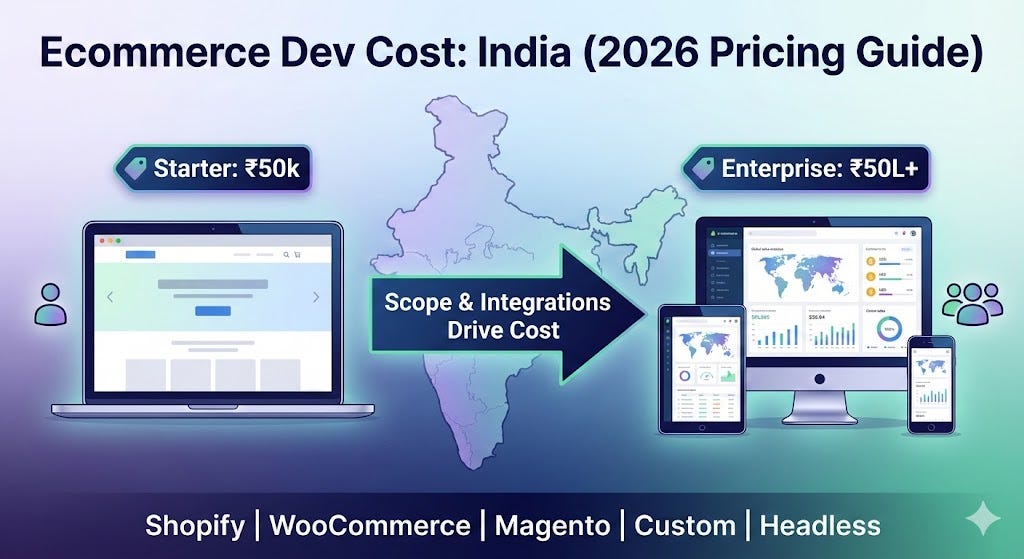
If you have researched e-commerce development cost in India, you have likely encountered a confusing reality: one agency quotes ₹50,000, while another quotes ₹50 Lakhs for what sounds like the same requirement.
Why is there such a massive gap?
The truth is, “e-commerce website” is a broad term. It can refer to a pre-made template installed in two days, or a custom-architected enterprise solution capable of handling millions of concurrent transactions. India offers a significant cost advantage compared to Western markets—often 30% to 50% cheaper—but the final price tag depends entirely on your scope, technical architecture, and the team you hire.
In this guide, we break down the realistic cost of an e-commerce website in India for 2026. Whether you are a startup looking for a Minimum Viable Product (MVP) or an established brand seeking a headless commerce solution, this breakdown will help you budget accurately.
If you only remember one thing from this guide: Integrations and scope drive 70% of your total cost, not just the design.
Quick Answer: Typical E-commerce Development Cost in India
If you are looking for a quick estimate, here is a snapshot of the current market rates for 2026. Note that these are delivery ranges; the exact pricing depends on the specific features and integrations discussed later in this post.
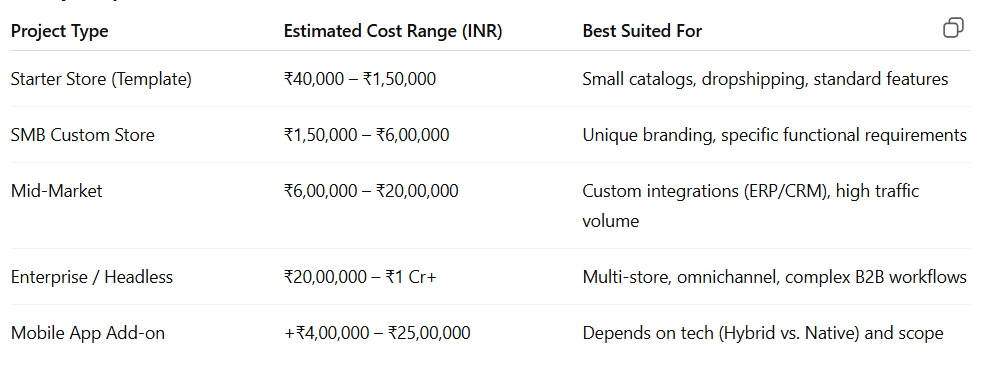
If you’re planning an e-commerce project, the cost can vary widely depending on scale and complexity.
A starter store built on a template typically costs between ₹40,000 and ₹1,50,000. This option works best for small product catalogs, dropshipping businesses, or brands that just need standard ecommerce features to get online quickly.
For growing businesses, an SMB custom store usually falls in the ₹1,50,000 to ₹6,00,000 range. This is ideal when you need unique branding, custom layouts, or specific functional requirements beyond off-the-shelf templates.
A mid-market ecommerce store can cost anywhere from ₹6,00,000 to ₹20,00,000. These projects are designed for higher traffic and often involve custom integrations with systems like ERP or CRM to streamline operations.
At the top end, enterprise or headless commerce builds typically start at ₹20,00,000 and can go beyond ₹1 crore. These solutions are built for multi-store setups, omnichannel experiences, and complex B2B workflows that demand flexibility and performance at scale.
Finally, adding a mobile app to your e-commerce ecosystem usually requires an additional ₹4,00,000 to ₹25,00,000, depending on whether you choose a hybrid or native app and how feature-rich the app needs to be.
What You’re Actually Paying For (Cost Components Breakdown)
When an agency provides a quote for e-commerce website development, they aren’t just charging for “coding.” A professional build involves several layers of expertise to ensure the site is secure, scalable, and capable of generating revenue.
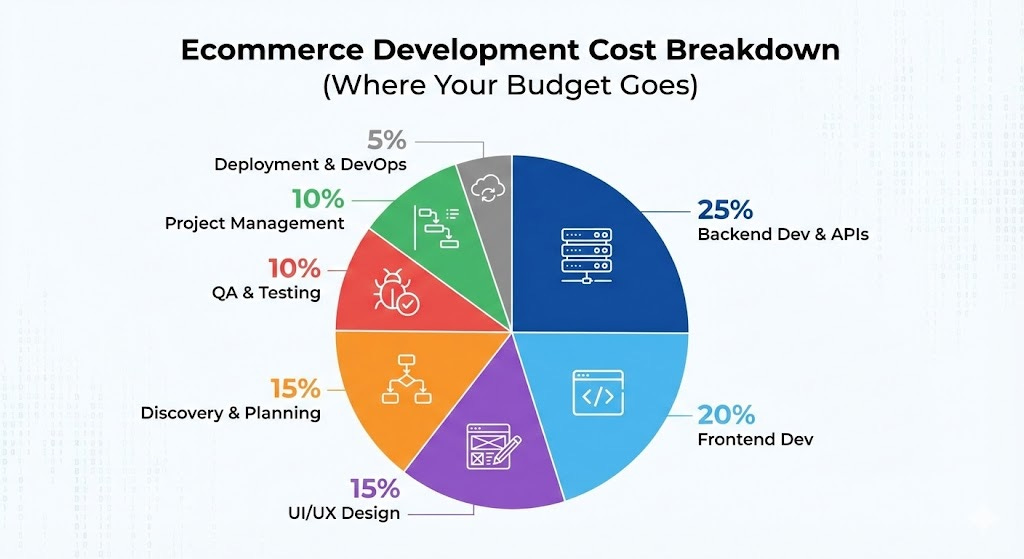
Here is where your budget goes:
Discovery & Requirements (10-15%): This is the blueprint phase. It involves workshops to define user flows, technical architecture, and functionality. Without this, projects face scope creep.
UI/UX Design (15-20%): This moves beyond simple graphics. It includes wireframing, creating a design system for consistency, and ensuring responsive layouts that convert visitors into buyers.
Frontend Development (20-25%): The visual “storefront” your customers interact with. Costs rise with requirements for high performance (Core Web Vitals), accessibility compliance, and interactive elements.
Backend Development (25-30%): The engine room. This involves setting up the product catalog, inventory logic, complex pricing rules, and API connections.
Admin & Operations: Configuring the back-office for order management, returns processing, coupon logic, and tax rules.
QA & Testing: Rigorous testing across devices, payment flow verification, and security checks to prevent downtime during sales.
Deployment & DevOps: Setting up secure hosting, CI/CD pipelines for smooth updates, and automated backups.
Note: “Cheap builds” often fail because they skip Discovery, QA, and DevOps, leading to security vulnerabilities and poor SEO performance later.
E-commerce Pricing Models in India (How Agencies Quote)
Understanding how e-commerce development agency pricing in India works is as important as the total cost. Agencies generally offer four models:
1. Fixed Price
Best for: Stable scopes with well-defined requirements (e.g., a standard Shopify store). You pay a set amount for a specific list of deliverables. If you add features later, they are charged as “change orders.”
2. Time & Material (T&M)
Best for: Evolving products, complex custom builds, or startups iterating on feedback. You pay hourly or daily rates for the developers’ time. This offers maximum flexibility but requires strict budget monitoring.
3. Monthly Retainer / Dedicated Team
Best for: Long-term projects and continuous development. You hire a dedicated team (e.g., 1 React Developer, 1 QA, 0.5 PM) for a fixed monthly fee. This is often the most cost-effective model for mid-to-large enterprises.
4. MVP-First Model
Best for: fast go-to-market strategies. The agency builds the “Minimum Viable Product” to launch quickly, then iterates based on user data.
Decision Tip: If you need to launch in under 30 days, choose a Fixed Price template approach. If you are building unique workflows, opt for T&M.
Cost by Platform Choice
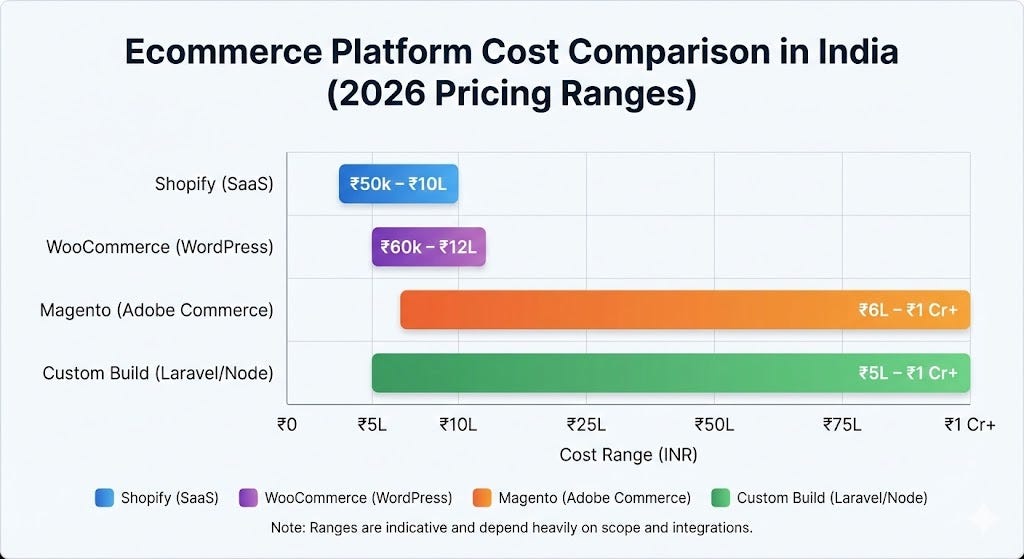
The technology stack is the single biggest factor influencing the cost of an e-commerce website in India. Here is a breakdown by platform:
5.1 Shopify (SaaS)
Shopify is a hosted solution, meaning you pay a monthly subscription plus development costs.
Basic Setup + Theme: ₹50,000 – ₹2,50,000
Custom Theme Dev + Apps: ₹2,50,000 – ₹10,00,000
Pros: Fastest time-to-market, reliable hosting, huge app ecosystem.
Cost Drivers: Paid apps (recurring monthly costs), Shopify Plus fees for high volume, and limitations on checkout customization.
5.2 WooCommerce (WordPress)
The most popular open-source platform, running on WordPress.
Template Store: ₹60,000 – ₹3,00,000
Custom Build + Plugins: ₹3,00,000 – ₹12,00,000
Pros: Excellent for content marketing (SEO), full ownership of code, and lower initial cost.
Cost Drivers: “Plugin sprawl” (using too many plugins slows the site), performance tuning, and ongoing security hardening.
5.3 Magento / Adobe Commerce
A powerhouse for large catalogs and complex B2B needs.
SMB Magento Build: ₹6,00,000 – ₹25,00,000
Enterprise Solution: ₹25,00,000 – ₹1 Cr+
Pros: Unmatched scalability, multi-store capabilities, complex product configurations.
Cost Drivers: High development complexity (requires specialized Magento devs), expensive hosting requirements, and regular patches.
5.4 Custom Development (Laravel / Node / Django / NET)
Building from scratch without a pre-made CMS.
MVP Custom: ₹5,00,000 – ₹20,00,000
Enterprise Custom: ₹20,00,000 – ₹1 Cr+
Pros: Total control over logic, no platform constraints, unique workflows.
Cost Drivers: You build everything from scratch (security, admin panel, reporting), requiring high-seniority developers.
5.5 Headless Commerce (Next.js + API Backend)
The modern standard for enterprise flexibility, decoupling the frontend from the backend.
Headless Build: ₹15,00,000 – ₹1.5 Cr+
Pros: Incredible speed, superior UX, omnichannel readiness.
Cost Drivers: Integrating multiple systems via API, managing content operations, and complex DevOps.
Cost by Feature Set (Most Common Add-ons)
When calculating the custom e-commerce development cost in India, you must account for specific features. We can group these into tiers:
6.1 Core Store Features (Baseline)
Included in most base packages.
Product catalog, simple search, filtering.
Cart, checkout, customer accounts.
Basic tax calculation, standard shipping zones.
Order confirmation emails.
6.2 Growth Features (Increases Cost)
Advanced Search: Integration with Algolia or ElasticSearch for instant results.
Multi-Currency/Language: Essential for export businesses.
Subscriptions: Recurring billing logic.
Marketing Tools: Bundles, upsells, cross-sells, loyalty points, and referral engines.
6.3 Operational & Integration Features (Largest Cost Driver)
This is where costs often double.
ERP Integration: Syncing with Tally, SAP, Microsoft Dynamics, or Zoho.
CRM Integration: Connecting HubSpot, Salesforce, or Zoho CRM.
Logistics: Integrating shipping aggregators like Shiprocket, Delhivery, or FedEx APIs.
Payments: Advanced gateway setups (Razorpay, Stripe, PayU) and UPI flows.
Compliance: Automated GST invoicing and E-way bill generation.
6.4 Enterprise Features
Multi-store management (different storefronts for different regions).
B2B features: Custom pricing lists, bulk ordering, and purchase order (PO) approvals.
PIM (Product Information Management) and DAM (Digital Asset Management) systems.
E-commerce Website Cost vs. E-commerce App Cost in India
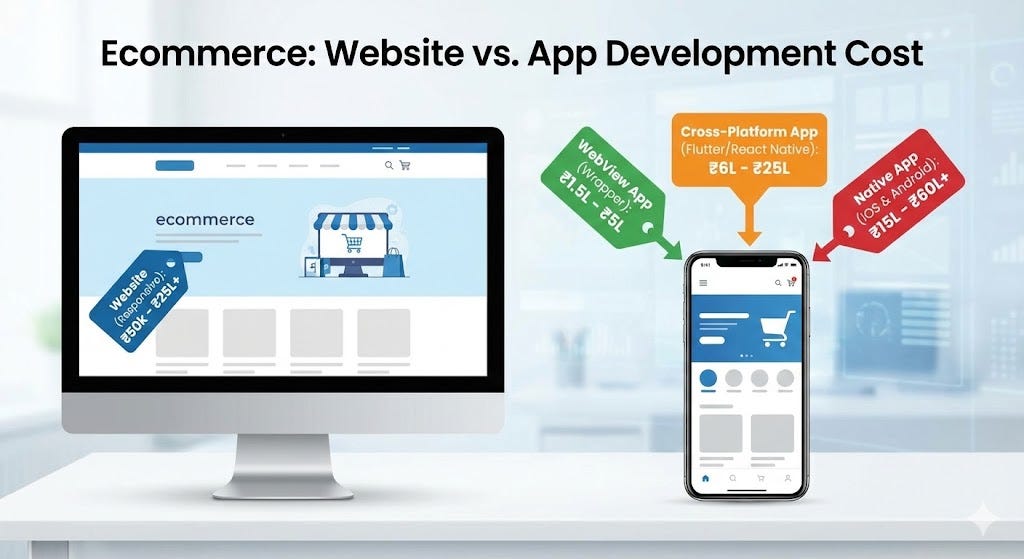
A common misconception is that an app costs the same as a website. In reality, ecommerce app development cost India can be significantly higher due to the complexity of mobile operating systems.
Webview App (Wrapper): ₹1,50,000 – ₹5,00,000. Essentially, the website is running inside an app container. Cheapest, but poor user experience.
Cross-Platform (Flutter / React Native): ₹6,00,000 – ₹25,00,000. A single codebase that runs on both iOS and Android. The industry standard for 2026.
Native App (Swift / Kotlin): ₹15,00,000 – ₹60,00,000+. Separate apps built specifically for iOS and Android. Highest performance but double the maintenance cost.
Major Cost Drivers: Push notifications, offline browsing capabilities, and syncing user data across web and mobile.
Hidden Costs Most Businesses Miss
When budgeting for Shopify / WooCommerce / Magento costs in India, ensure you account for these often-overlooked expenses:
Hosting & Infrastructure: Cloud hosting (AWS, DigitalOcean), CDNs for speed, and email services (AWS SES) can cost ₹5k–₹50k/month.
Payment Gateway Fees: Transaction fees (usually 2%) plus annual maintenance charges.
Plugin/App Subscriptions: In Shopify and WooCommerce, premium plugins can add up to ₹10k–₹40k/month.
Content Production: High-quality product photography, videography, and professional copywriting are crucial for conversion.
Technical SEO: Setting up Schema markup, Core Web Vitals optimization, and URL redirects requires specialist time.
Legal & Compliance: Privacy policies, cookie consent managers, and GST compliance audits.
Ongoing Maintenance Cost in India
Building the site is just the beginning. To keep your store secure and functional, you need an e-commerce maintenance cost in India budget.
Basic Maintenance (₹10,000 – ₹40,000 / month): Includes security patches, plugin updates, uptime monitoring, and minor bug fixes.
Growth Support (₹40,000 – ₹1,50,000 / month): Includes the above plus performance optimization, minor feature enhancements, and monthly reporting.
Enterprise Support (₹1,50,000 – ₹6,00,000+ / month): Dedicated developers for continuous integration, high-traffic server management, and 24/7 uptime guarantees.
What’s NOT included: Major redesigns, new large-scale integrations, or building entirely new modules usually fall under separate project scopes.
How to Reduce Costs Without Destroying Quality
You don’t have to sacrifice quality to save money. Here is how to optimize your e-commerce website development cost in India:
Start with an MVP: Identify the top 20% of features that will drive 80% of your revenue. Launch with those and iterate later.
Align Platform with Business Model: Don’t build a custom Laravel site if a Shopify store can handle your needs. Don’t use Magento for a catalog of 50 products.
Use Proven Themes: Instead of designing from zero, customize a high-quality, pre-existing theme or component library.
Avoid Plugin Bloat: Use fewer, high-quality plugins rather than dozens of cheap ones. It saves money on maintenance and debugging later.
Prioritize Performance Early: Fixing a slow site after launch is 3x more expensive than building it correctly the first time.
How to Choose the Right E-commerce Development Partner
The agency you choose will determine the success of your investment. Use this checklist when vetting partners:
Relevant Portfolio: Have they built stores with similar complexity (B2B/B2C, similar catalog size, integrations)?
Performance Benchmarks: Ask to see the Core Web Vitals and load times of their recent live projects.
SEO Readiness: Do they understand technical SEO, schema, and URL structures?
Security Practices: Ask about their approach to OWASP standards and PCI compliance.
Transparent Scope: Do they provide a detailed Scope of Work (SOW) before starting?
Post-Launch Support: What are their SLAs (Service Level Agreements) for bugs and downtime?
Warning Signs: Avoid agencies that offer quotes that seem “too cheap” without a discovery phase, or those that do not offer a staging environment for testing.
Budgeting Worksheet: What to Share for a Quote
To get an accurate e-commerce development agency pricing in India quote, share the following details with your potential partner:
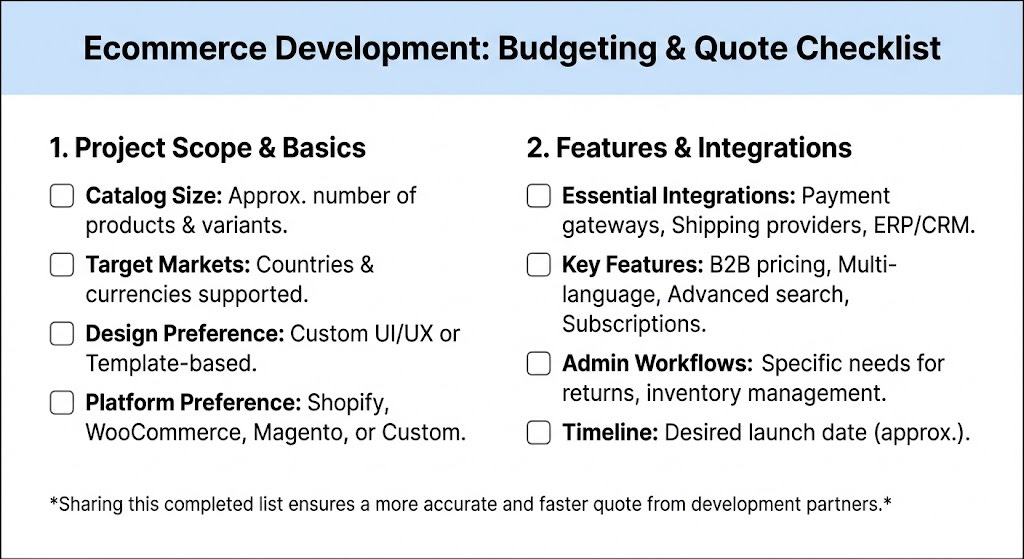
Catalog Size: Number of products, SKUs, and variants.
Markets: Countries you sell to and currencies required.
Payment & Shipping: specific gateways and logistics partners needed.
Integrations: List of all 3rd-party software (ERP, CRM, Marketing tools).
Design Preference: Custom design vs. Template customization.
Timeline: Your target launch date.
Admin Workflows: Specific needs for returns, exchanges, or invoicing.
Conclusion
While the e-commerce development cost in India is competitive globally, the real price varies based on your platform, feature set, and integration needs. A template-based store might cost you ₹50,000, while a scalable, custom enterprise platform can run upwards of ₹50 Lakhs.
The key is to choose a solution that aligns with your current business stage and roadmap, rather than just chasing the lowest initial quote. A cheap site that fails during a sale costs much more in lost revenue than a professionally built one.
Ready to get started? If you want an exact estimate, request a scope-based quote with your specific feature list and integrations today.
Frequently Asked Questions (FAQ)
What is the minimum cost to build an e-commerce website in India?
For a professional setup using a basic template on Shopify or WooCommerce, the minimum cost starts around ₹40,000 to ₹60,000. This covers the setup, basic theme customization, and payment gateway integration.
Shopify vs WooCommerce: which is cheaper long-term?
WooCommerce generally has a lower startup cost but can become expensive with premium plugins, hosting, and maintenance fees as you scale. Shopify has a higher recurring monthly fee but reduces technical maintenance costs. For many SMBs, Shopify is often cheaper in terms of “total cost of ownership” due to lower maintenance overhead.
How much does an e-commerce app cost in India?
An e-commerce mobile app typically costs between ₹4 Lakhs and ₹25 Lakhs. A cross-platform app (Flutter/React Native) is the most cost-effective route, costing around ₹6L–₹15L, whereas native apps for iOS and Android can exceed ₹20L.
What is the monthly maintenance cost?
For a standard SMB store, expect to pay between ₹10,000 and ₹40,000 per month for maintenance. This ensures your site remains secure, fast, and free of bugs.
How long does it take to build an e-commerce store?
A basic template store can be live in 2–4 weeks. A custom-designed store typically takes 8–12 weeks, while complex enterprise builds with deep integrations can take 4–6 months or longer.